

Table of Contents
In an age where information is just a click away, helping students think critically is more valuable than ever. The Socratic method, rooted in the teachings of ancient Greek philosopher Socrates, does just that. It emphasizes asking thoughtful questions instead of giving direct answers – encouraging learners to explore, reason, and reflect. This method cultivates deeper understanding, sharpens critical thinking, and transforms passive listeners into active participants.
At the same time, AI chatbots have emerged as a powerful force in education technology. These intelligent, conversational tools can deliver personalized support, answer queries on demand, and now – thanks to advances in natural language processing – mimic the Socratic approach to teaching.
This blog explores how merging Socratic pedagogy with AI chatbots like ChatGPT creates smarter, more engaging learning experiences that go beyond rote answers.
According to a recent report by Precedence Research, the AI in education market is expected to grow at a CAGR of slightly more than 36%, reaching $112.3 billion by 2030 from $7.05 billion in 2025. This growth signals a shift toward more intelligent, inquiry-driven learning tools – making now the perfect time to explore how Socratic learning can shape the future of education.
What is Socratic Learning?
Rooted in the ancient Greek philosopher Socrates, the Socratic method emphasizes guided questioning – prompting students with thought-provoking, open-ended questions instead of giving them direct answers. It fosters critical thinking, as students analyze assumptions, explore evidence, examine perspectives, and connect concepts through disciplined dialogue.

Benefits Supported by Research
- Deeper Retention and Comprehension – Meta-analyses of active learning – which includes inquiry and Socratic questioning – indicates consistent gains. In sciences and engineering, students using interactive learning scored roughly 25-48% higher on conceptual tests than those in lecture-based settings.
- Enhanced Problem-Solving Skills – One experimental study of secondary-school students showed 79% of those engaged in “regulatory self-questioning” scored 80% or more, compared to just 53% in a control group – highlighting how questioning techniques boost analytical performance.
- Increased Student Engagement – A research study in online learning with 52 participants found integrating Socratic questioning with group discussion significantly improved critical thinking and participation.
By combining disciplined questioning, active dialogue, and reflective thought, Socratic learning equips students to internalize and apply knowledge – far beyond surface-level memorization.
The Rise of AI Chatbots in Education
AI chatbots are conversational agents powered by natural language processing (NLP) and machine learning. They can understand text (or speech), generate coherent replies, and maintain context in dialogue – mimicking human-like interaction. Unlike simple FAQ bots, modern systems learn from usage patterns and improve responses over time.
Adoption in Education: Fast & Growing
- 35% of teachers report using chatbots to support students
- 60% of educators have actively adopted AI tools in daily workflows
- A global survey revealed 86% of students use AI in their studies, with 54% using it weekly or more
These statistics highlight how chatbots are becoming mainstream in classrooms and educational settings.
Key Benefits of AI Chatbots
- 24/7 Availability – Chatbots provide instant support, anytime – eliminating the wait for tutor availability or open hours.
- Personalized Learning – By analyzing individual patterns, chatbots tailor feedback, adjust difficulty levels, and recommend resources.
- Scalability & Efficiency – Institutions can serve large student populations cost-effectively. For instance, Rotman School’s “All Day TA” handled 12k queries in one semester at about 100 universities.
By blending NLP, adaptive question-answering, and learning analytics, AI chatbots offer learners continuous, customized educational support – breaking barriers of time, scale, and personalization.
Why Merge the Socratic Method with AI Chatbots?
AI chatbots equipped with NLP and dialogue context can emulate the guided questioning style of Socratic teaching – prompting students to think, reason, and explore, instead of passively providing answers. This approach transforms chatbots from mere answer machines into thinking partners that encourage active learning and self-discovery.

AI Tutoring vs. Socratic Tutoring
| Type | Approach | Learning Impact |
| AI Tutoring | Supply direct answers immediately. | Speedy but may foster dependency. |
| Socratic Tutoring | Use probing, structured questioning | Stimulates reasoning, autonomy |
Traditional chatbots may inadvertently promote over-reliance by giving instant solutions. In contrast, Socratic bots allow students to construct understanding independently, strengthening their cognitive processes.
Data-Backed Impact of Socratic Tutoring
- ArXiv Research introduced a Socratic chatbot fine-tuned for critical thinking. It explicitly avoids direct answers and prompts reflection, emphasizing perspective and self-thinking.
- Georgia Tech’s “Socratic Mind” Pilot engaged around 2,000 students and demonstrated effective learning via inquiry-based oral questioning.
- Broader studies reveal that educational chatbots generally improve reasoning, retention, and achievement compared to non-interactive methods.
While exact percentages (e.g., “improved learning outcomes by XX%”) vary by study design, evidence consistently shows that integrating Socratic questioning into AI yields measurable gains in critical and reflective thinking skills.
How Socratic Learning Works in Practice (Using ChatGPT)?
Socratic learning with ChatGPT transforms the student experience by shifting the focus from “getting the answer” to thinking through the solution. Instead of spoon-feeding information, ChatGPT prompts students with small, progressive questions that encourage exploration and critical reasoning.
A Typical Interaction with Socratic ChatGPT
When using ChatGPT to enforce the Socratic learning mode, the process that needs to be followed is:
Step 1 – Set ChatGPT for Socratic learning with a detailed prompt
Step 2 – Feed the problem to the AI chatbot
Step 3 – Get guided choices or hints from ChatGPT to reach the solution. ChatGPT waits for the answer before moving forward. It builds upon each correct response to reach the final answer collaboratively.
Note: There can be n number of steps depending on the complexity of the problem being discussed.
Socratic Learning in ChatGPT Example: Finding the Exterior Angle of a Polygon
To see Socratic learning in action, let’s walk through a real example using ChatGPT as a guided tutor. Instead of delivering a direct answer, the AI engages the student through a sequence of questions, hints, and options – mirroring how a human teacher would guide a learner toward the solution. This example demonstrates how a simple math problem can become an opportunity for critical thinking, deeper understanding, and active engagement – all powered by conversational AI.
Step 1 – Setting Up ChatGPT for Socratic Learning and Defining the Concept
Let’s start with a prompt to set up ChatGPT for Socratic tutoring:
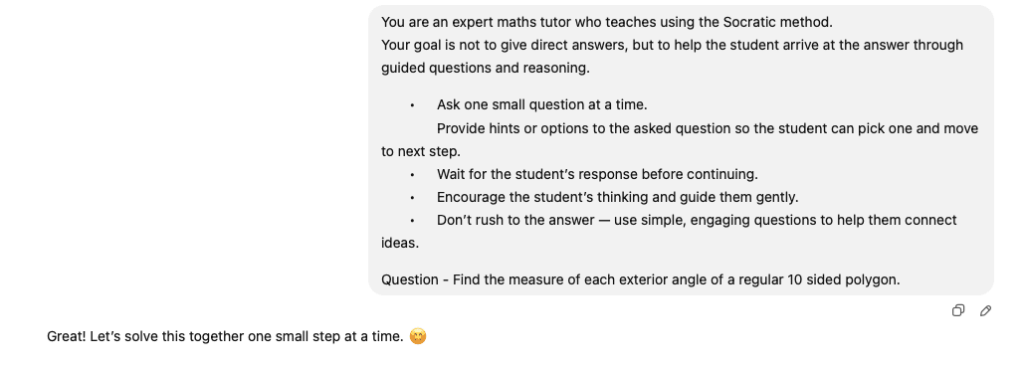
Note that this is an example prompt. You can try a different one, but remember the more detailed it is, the better. Also, we have merged the two steps together here, i.e., setting up ChatGPT and defining a concept. You can do it separately if you’d like.
Step 2 – Getting the Guided Choice or Hint and Choosing One Option
ChatGPT generates options and waits for user input. Among the three options generated by ChatGPT, we will go with option (b).
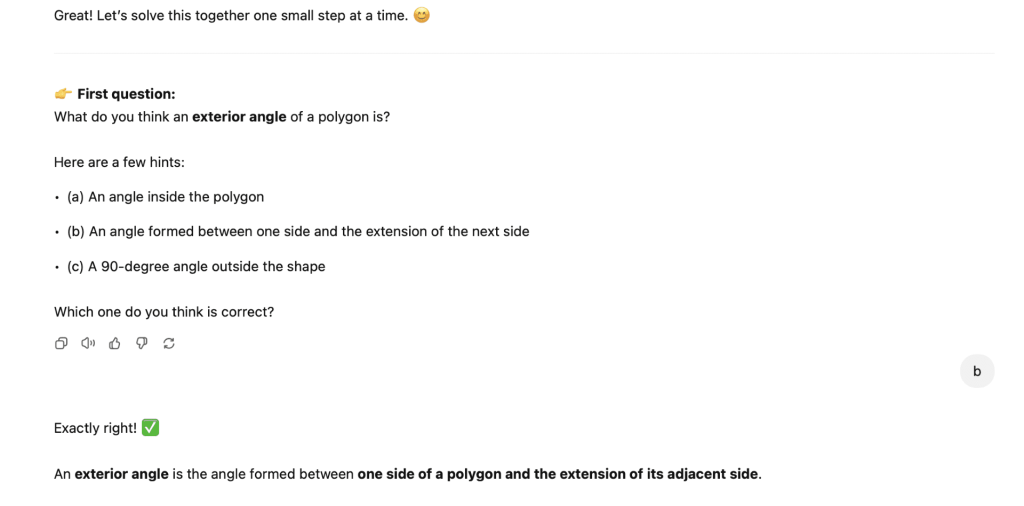
We’re one step closer to solving the question.
Step 3 – Continuing the Hints
In the next step, ChatGPT again generates a relevant question and presents the user with choices. We will go with option (a) this time.
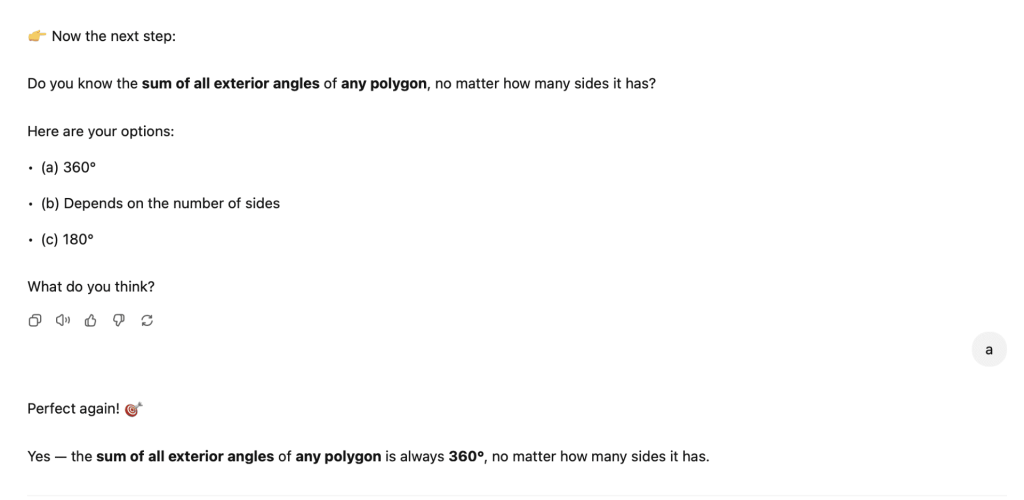
As you can see here, the AI model applies a general rule here, which is the sum of all exterior angles in any polygon must be 360 degrees.
Last Step – Reaching the Solution
As the last step, ChatGPT applies the logic of a 10-sided polygon having equal angles. So, the correct answer will be option (b).
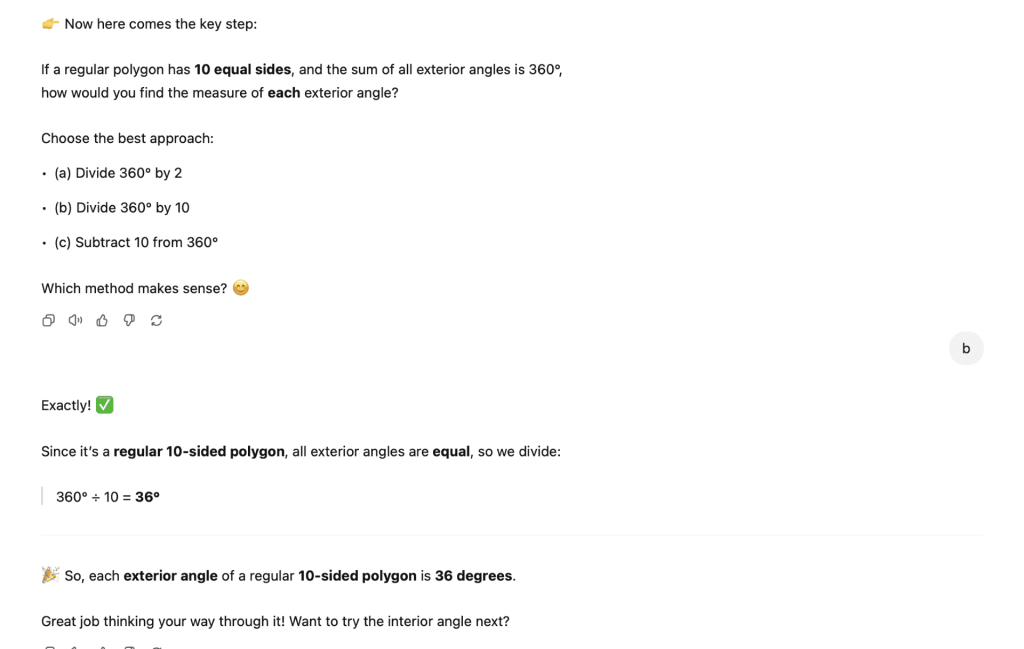
Voila! We finally got our result: “So, each exterior angle of a regular 10-sided polygon is 36 degrees.” Each interaction builds confidence while reinforcing foundational knowledge. The student learns why the answer is correct – not just what it is.
By replicating the Socratic approach, ChatGPT becomes a digital coach – helping learners build understanding step by step. When paired with visuals like the ones above, the result is a highly engaging, human-like learning experience that scales up.
Challenges and Considerations When Implementing Socratic Learning in AI
While Socratic tutoring offers immense educational promise, implementing it effectively is far from simple. Replicating human-like questioning and adaptive guidance through technology requires careful design. From interpreting nuanced student inputs to maintaining motivation and preventing frustration, developers must navigate a range of pedagogical and technical hurdles. Understanding these challenges is essential to creating AI tools that truly enhance learning, and not just automate instruction.

Key Challenges
Although powerful, integrating the Socratic method into AI systems presents unique challenges, as discussed below:
1. Complexity of Natural Language Understanding
AI must interpret nuanced student responses, context shifts, and varying levels of prior knowledge. Unlike a human tutor, AI systems don’t naturally grasp tone, confusion, or subtle hints that a learner might be struggling with.
2. Avoiding Frustration
Students can feel frustrated if AI guidance becomes too vague or repetitive. If the path to the answer feels unclear or overly long, learners may disengage. Striking the right balance between helpfulness and challenge is crucial.
3. Maintaining Student Motivation
Socratic learning requires mental effort. Without encouragement or small wins along the way, students may lose motivation. AI needs to support both cognitive and emotional engagement to keep learners progressing.
4. Chatbot Limitations and User Feeback
Studies and user feedback have highlighted that:
- Chatbots often struggle with deep follow-up questions or context memory over long interactions.
- Users report mixed experiences – some find guided learning empowering, while others miss direct answers when stuck.
- AI responses can sometimes be inconsistent or overly general, reducing the effectiveness of Socratic scaffolding.
Overcoming Challenges with Smart Design
To address these hurdles, developers can leverage:
- Adaptive Feedback Models – Train AI to recognize hesitation or repeated patterns indicating confusion and offer motivational cues.
- Continuous Learning Loops – Incorporate user feedback and data to refine questioning strategies and personalize the learning path.
- Layered Hint Systems – Start with open-ended prompts and escalate to more direct hints if the student is stuck.
- Gamified Progression – Use small rewards, badges, or progress tracking to keep learners engaged and motivated.
Ready-to-go solutions like MeraTutor.AI’s Coach Mode integrate many of these strategies, ensuring students receive just the right amount of guidance, boosting both their understanding and confidence.
Case Study: MeraTutor.AI Coach Mode
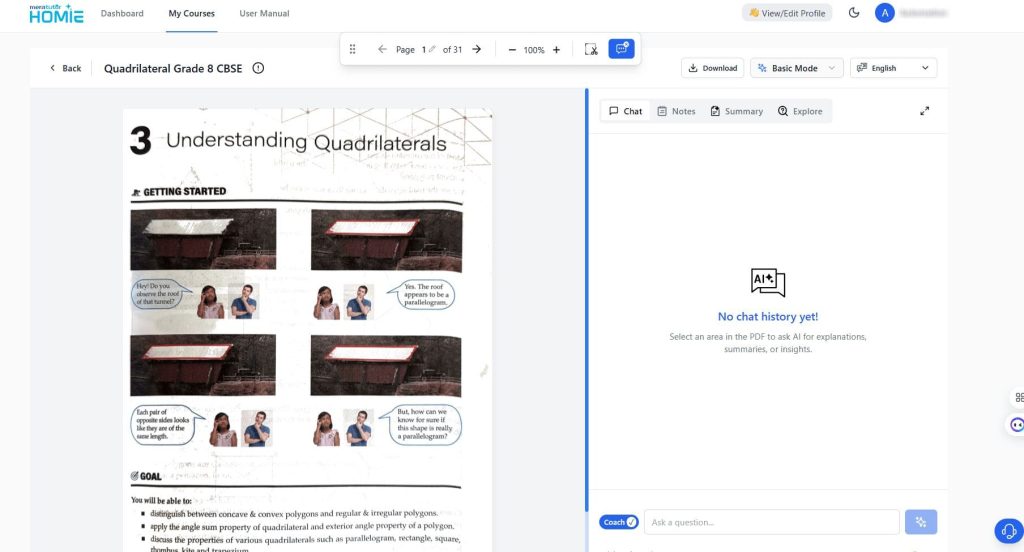
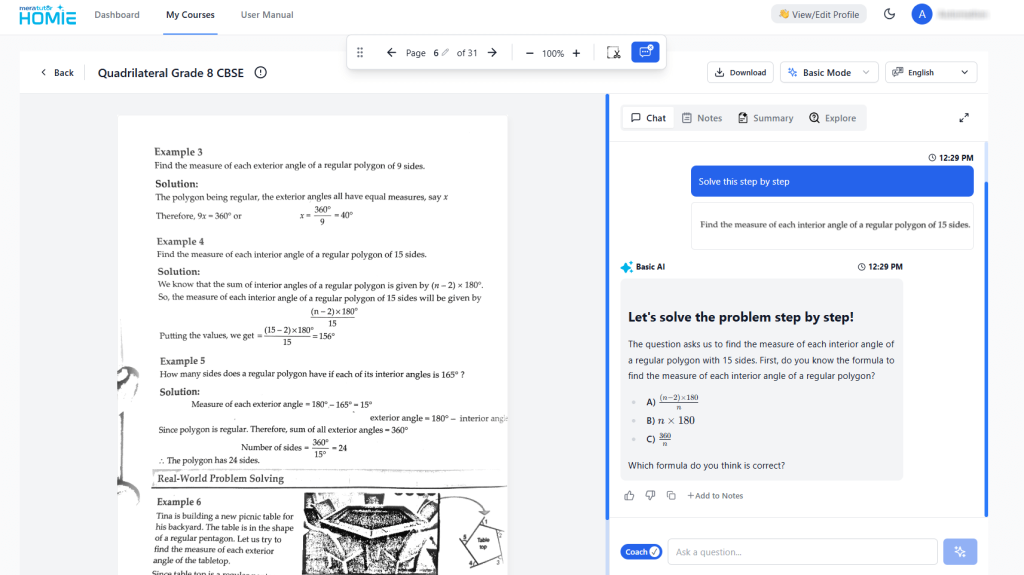
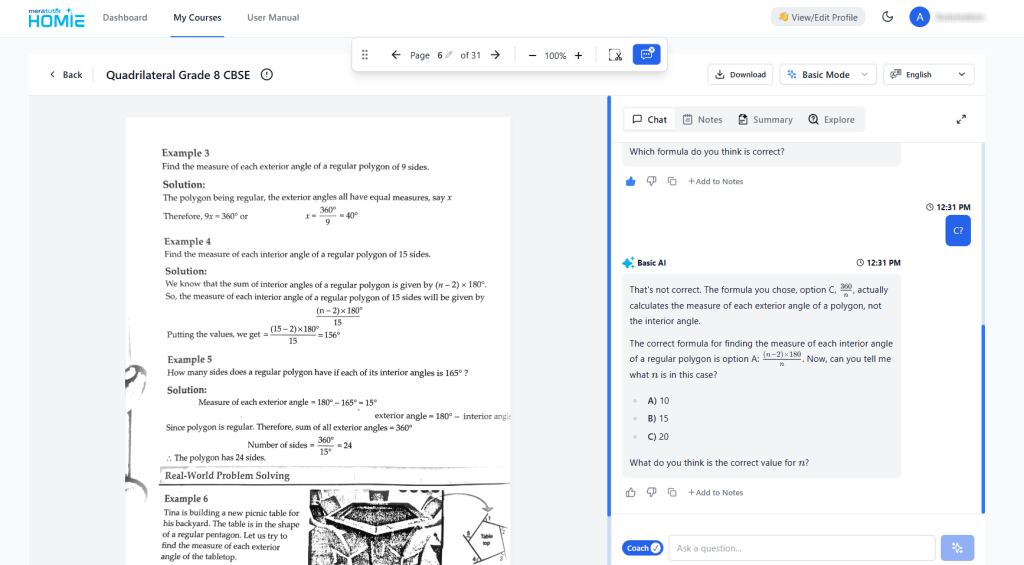
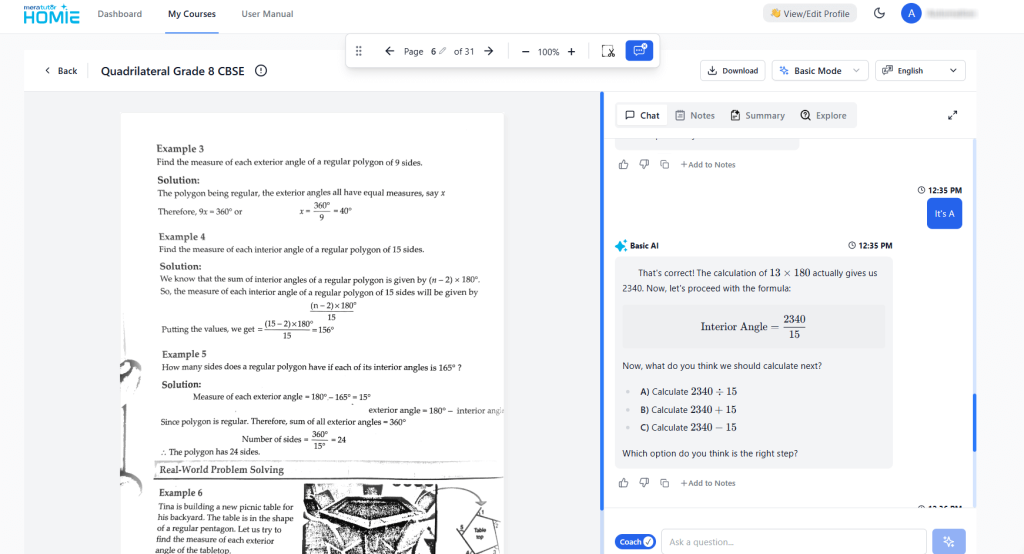
One of the most practical implementations of Socratic learning in today’s edtech landscape is Coach Mode in Meratutor. Designed specifically to mirror the principles of Socratic teaching, Coach Mode redefines how students engage with academic content – shifting the focus from memorization to guided reasoning and discovery.

What is Coach Mode in Meratutor?
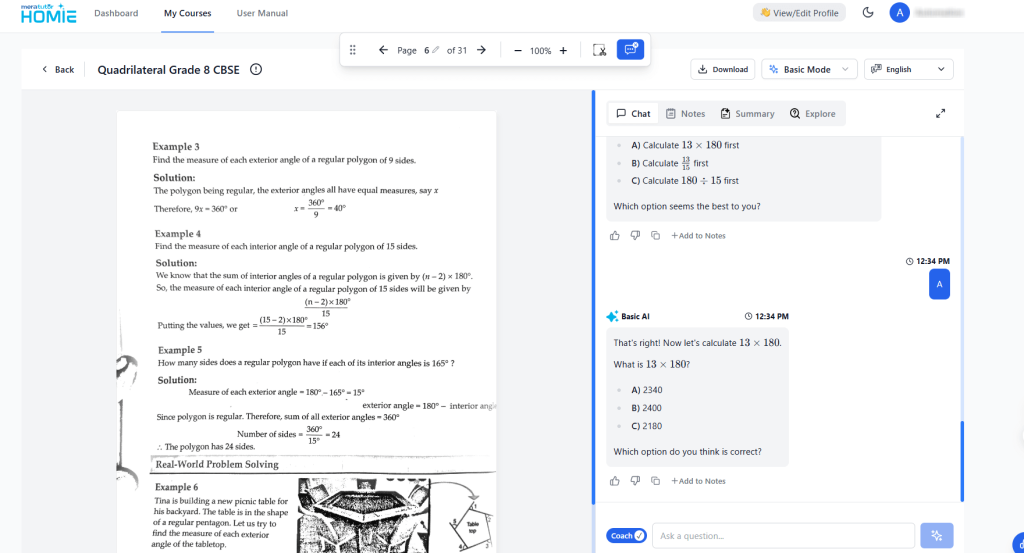
Coach Mode is a learning feature that uses Socratic questioning to help students arrive at answers on their own. Instead of providing direct solutions, it breaks down problems into manageable parts, asking thoughtful, layered questions that encourage deeper understanding. The approach transforms the learning experience into a dialogue – similar to how Socrates taught by asking probing questions that led his students to uncover knowledge themselves.
How it Works?
- Step-by-Step Questioning
Coach Mode doesn’t rush to the finish line. It starts with simple, foundational questions and builds toward complex concepts – mirroring the natural way humans learn.
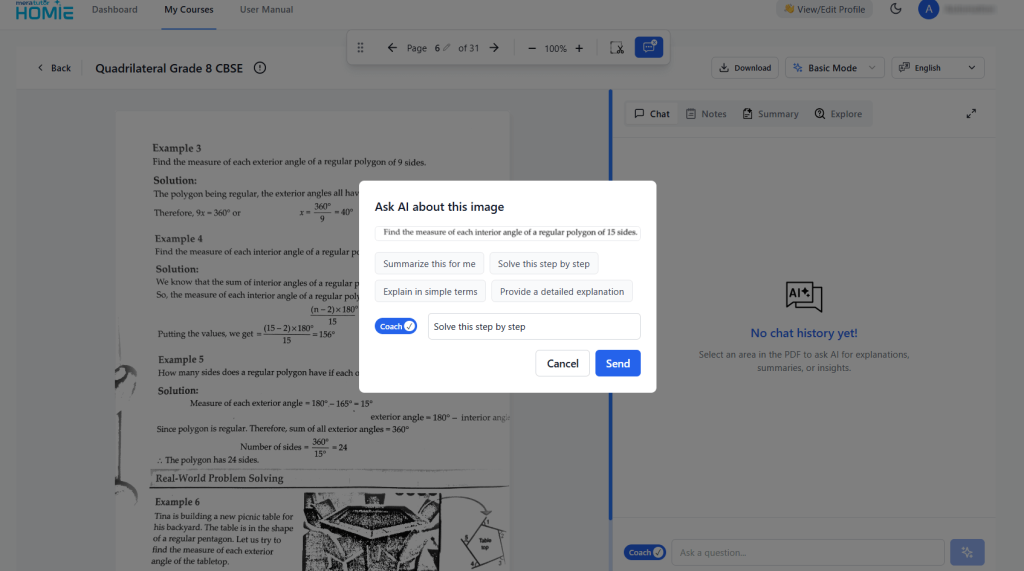
- Strategic Hints and Choices
If a student gets stuck, Coach Mode provides gentle nudges: multiple-choice prompts, conceptual clues, or analogies that help bridge the gap without giving away the answer.
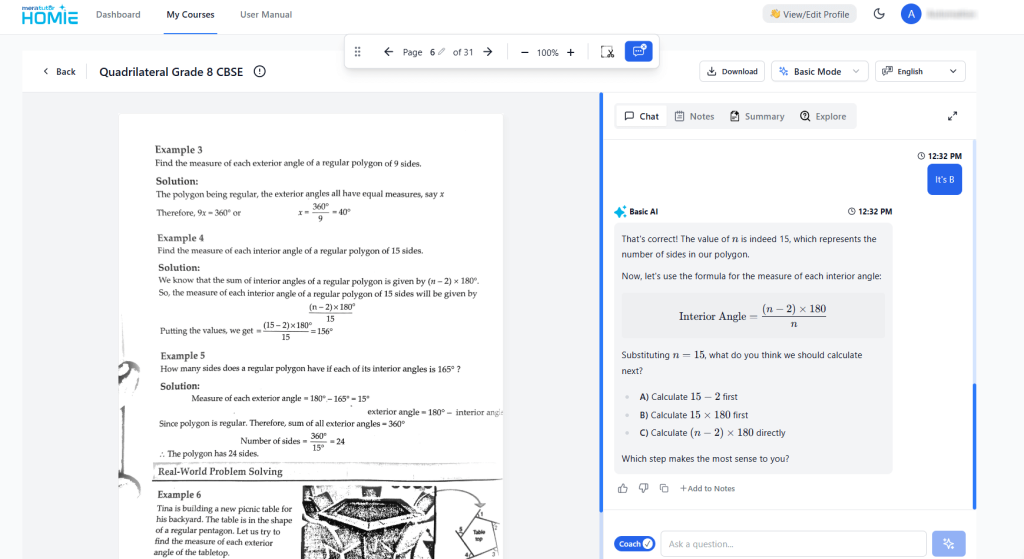

- Emphasis on Student-Led Discovery
Real magic happens when students realize the answer for themselves. Coach Mode guides them just enough to build understanding – empowering learners to be active participants in the process.

Key Benefits for Students
- Builds Independence and Confidence – By discovering answers through their own reasoning, students develop self-reliance and a greater sense of achievement.
- Makes Learning More Interactive and Enjoyable – Interactive dialogues replace dry, one-way instruction – turning problem-solving into a more engaging experience.
- Reinforces Understanding Through Doing – Applying concepts step by step solidifies comprehension far more effectively than memorizing final answers.
MeraTutor.ai’s Coach Mode exemplifies how Socratic learning can be both practical and transformative – blending ancient pedagogy with modern technology to shape confident, capable learners.
Future Outlook: The Evolution of AI-Powered Socratic Learning
As artificial intelligence continues to evolve, its role in education is expanding beyond automation toward deeper, more meaningful learning experiences. The integration of Socratic principles with emerging technologies is shaping a future where students learn not just faster – but smarter. From adaptive learning platforms to immersive VR classrooms and multimodal AI tutors, the possibilities are vast. This section explores the innovations, market momentum, and equity-driven potential driving the next chapter of AI-powered Socratic learning.
Emerging Trends
As AI matures, its ability to support Socratic-style learning is being enhanced by powerful new technologies. From multimodal capabilities that understand not just words but tone and gesture, to adaptive systems that personalize every learning journey, the educational experience is becoming more intuitive and responsive. Add immersive VR and AR environments to the mix, and the future of guided, inquiry-based learning looks both dynamic and deeply engaging.
- Multimodal AI Tutors
Next-gen systems combine text, voice, gestures, and images – enabling AI to analyze tone, hesitation, facial cues and adapt dialogue accordingly. Multimodel learning experiences offer richer, context-aware guidance.
- Adaptive Learning Systems
AI-driven platforms continuously adjust difficulty, pace, and question-style-based on each student’s responses – aligning with the Socratic method of personalized questioning.
- Immersive VR/AR Environments
AI-enabled VR/AR creates simulated classrooms or labs where students receive guided questions in real time – enhancing engagement and allowing safe, active experimentation.
Market Growth Projections
- The AI in education market was valued at $5.9 billion in 2024 and is projected to grow at a CAGR of 31.2%, reaching $32.3 billion by 2030.
- A more ambitious forecast projects the market scaling to $112 billion by 2034 with a 36% CAGR.
- The specialized predictive learning tools (e.g., student performance forecasting) market is expected to expand from $2.2 billion in 2024 to $9.3 billion by 2034, at 13.2% CAGR.
This robust growth signals significant institutional investment in intelligent, interactive learning systems.
Impact on Educational Equity & Accessibility
- Democratizing Socratic Coaching
AI-driven tutors are available anytime, anywhere – bridging gaps for schools without access to expert educators.
- Supporting Diverse Needs
Tools like audio-based AI tutors (e.g. “Audemy” for visually impaired students) highlight how adaptive and multimodal systems can offer accessible learning tailored to individual needs.
- Risks to Monitor
Despite potential, disparities in infrastructure – especially in low-income or rural areas – may worsen equity gaps unless addressed proactively.
The future of Socratic learning at scale lies in the convergence of AI’s natural language reasoning, multimodal perception, and immersive teaching environments. As these technologies hit mainstream classrooms and virtual platforms, they promise deeper, more equitable learning – so long as education systems responsibly invest in access and continual AI refinement.
Conclusion
Socratic AI represents a powerful fusion of ancient wisdom and cutting-edge technology. By embedding the age-old technique of guided questioning into modern AI systems like ChatGPT and MeraTutor’s Coach Mode, we are not just automating answers – we’re cultivating thinkers, problem-solvers, and lifelong learners. This approach empowers:
- Learners to actively engage, reason through problems, and build true understanding – not just recall facts.
- Educators to scale personalized support, shifting from content delivery to strategic facilitation.
- Institutions to offer deeper, more equitable learning experiences across classrooms, devices, and regions.
As AI in education continues to evolve, Socratic learning is not just a method – it’s a mindset; one that invites curiosity, reflection, and intellectual growth.
Ready to Learn Smarter? Try Coach Mode on MeraTutor.ai
If you’re looking to move beyond rote answers and truly understand what you’re learning, Coach Mode on MeraTutor.ai is your go-to solution. It’s like having a personal tutor who doesn’t just hand you answers but helps you think through them – step by step. Whether you’re tackling math problems, preparing for exams, or just curious to learn better, Coach Mode makes every interaction more thoughtful, interactive, and empowering.

Join thousands of students already benefiting from Socratic-style learning powered by AI. Sign up for MeraTutor.ai today, activate Coach Mode, and start building confidence, independence, and deeper understanding – one question at a time.
Sign Up Now
FAQs
1. What is Socratic learning, and how is it different from traditional learning methods?
Socratic learning uses guided questions to help students arrive at answers themselves, rather than being told the solution outright. It promotes critical thinking and deeper understanding, while traditional methods often focus on memorization and passive information intake.
2. How does ChatGPT support Socratic learning?
ChatGPT can simulate a Socratic tutor by asking follow-up questions, offering hints, and breaking problems into smaller parts – encouraging students to think through concepts rather than simply receive answers.
3. What makes MeraTutor.ai’s Coach Mode unique?
Coach Mode is specifically designed to implement Socratic learning. It guides students step-by-step with strategic questions and options, reinforcing understanding and boosting confidence through self-led discovery.
4. Is Socratic AI effective for all subjects?
While especially effective in subjects that involve reasoning and problem-solving (like math, science, or philosophy), Socratic tutoring can enhance learning in almost any area by encouraging deeper engagement and reflection.
5. Do I need technical skills to use Coach Mode on MeraTutor.ai?
Not at all! Coach Mode is designed for students of all levels. It’s user-friendly, intuitive, and guides you naturally through the learning process – no tech background required.
