

Table of Contents
Prompt engineering for tutors has become an essential skill as AI tools rapidly enter tutoring and education. From instant explanations to auto-generate practice questions, AI can dramatically reduce prep time and expand what tutors can offer students. AI tutoring platforms are making these capabilities more accessible than ever – but access alone isn’t enough to guarantee quality outcomes.
In the 2024-2025 school year, about 60% of K-12 teachers reported using AI tools in their work – often to prepare lessons, create activities, or modify materials – showing how widespread AI adoption already is among educators.
Many tutors quickly discover the same frustrations when using AI without structure. Explanations often come back too broad or generic, missing the student’s actual level of understanding. Practice questions may be technically correct yet poorly aligned with a learner’s grade, goals, or common mistakes. Over time, this can lead to a deeper concern:
“A loss of instructional control, where the tutor is reacting to AI output instead of leading the learning experience.”
This is where prompt engineering changes the equation. Rather than replacing tutor expertise, effective prompting allows tutors to direct AI with precision, much like giving clear instructions to a teaching assistant. With the right prompts, AI becomes a tool for educational support – generating explanations, examples, and quizzes that reflect the tutor’s intent, standards, and teaching style.
In this 2026 guide, the focus is on safe, simple, and repeatable prompt patterns designed for real tutoring use cases. You won’t find complex technical jargon or experimental tricks. Instead, you’ll learn practical approaches to using AI responsibly – so you stay in control of instruction while using technology to enhance, not dilute, your impact as a tutor.
Why Prompt Engineering for Tutors Matters?
Prompt engineering is a foundational skill for modern tutors using AI. Rather than focusing on tools alone, it highlights how clear instructions, responsible use, and thoughtful constraints determine the quality of AI-generated explanations and practice questions. Understanding these principles helps tutors use artificial intelligence as a reliable teaching assistant that supports learning goals while keeping instructional control firmly in the tutor’s hands.

#1 AI is Only as Good as the Prompt
One of the most important principles in prompt engineering for tutors is understanding that AI responds to the quality of instructions, not the tutor’s intent. AI tools don’t “know” what you mean—they only work with what you explicitly tell them. When prompts are vague, the output will be vague as well, regardless of how experienced the tutor is.
Consider the difference between a simple request like “Explain fractions” and a structured, tutor-grade prompt. The first leaves too many variables open:
- Grade level,
- Prior knowledge,
- Examples, and
- Learning goals.
A well-designed prompt, by contrast, specifies the student’s level, the explanation format, and the type of examples needed. On platforms like MeraTutor.AI, this level of clarity leads to explanations that are more accurate, targeted, and immediately usable in a tutoring session.
#2 Responsible AI Use in Education
As AI becomes more common in tutoring environments, one recommended action for schools and tutors is clear: teach explicit prompting and verification, not blind AI use. Artificial intelligence can be a powerful educational assistant, but only when its outputs are guided and reviewed by a human expert.
Tutors must actively review, adapt, and contextualize everything AI produces. This means checking explanations for accuracy, adjusting language to match the student’s understanding, and ensuring practice questions align with the lesson’s purpose. AI should support learning by reinforcing concepts and saving preparation time—not by encouraging passive consumption or unverified answers.
#3 Key Considerations When Prompting AI for Education
Effective educational prompt engineering prioritizes accuracy over creativity. While creative explanations can be helpful, correctness and clarity always come first in a tutoring context. Prompts should be carefully aligned with the student’s age, curriculum standards, and specific learning objectives to ensure relevance and consistency.
To reduce the risk of AI hallucinations or misleading responses, tutors should set clear boundaries within their prompts. This includes defining the scope of the topic, limiting assumptions, and asking the AI to show step-by-step reasoning where appropriate. These practices not only improve output quality but also reinforce good learning habits for students—making AI a reliable support tool rather than an unreliable shortcut.
The PARTS Framework Explained (Tutor-Friendly Prompting)
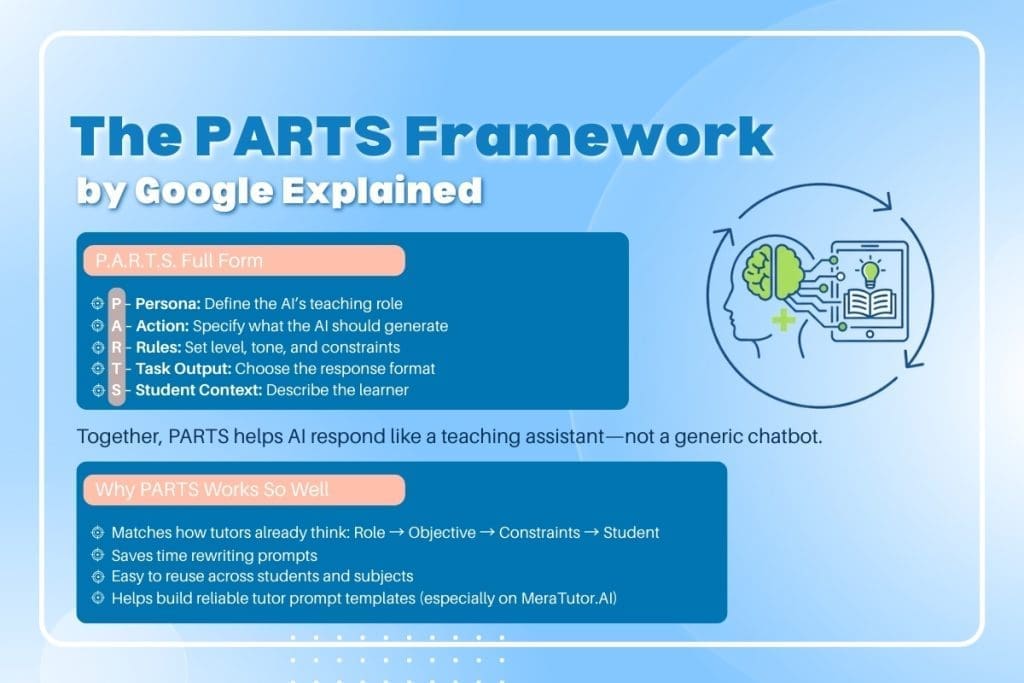
The PARTS framework by Google is a simple, tutor-friendly structure for writing clear and effective AI prompts. Its purpose—especially in educational and Gemini-style prompting—is to help tutors translate their teaching intent into instructions that AI can follow reliably. Instead of relying on trial and error, the PARTS framework ensures that AI responses remain consistent, safe, and instructionally relevant, which is essential for prompt engineering for tutors.
I. What Is the PARTS Framework?
Each part of the framework plays a specific role:
- P – Persona: Define the instructional role the AI should take, such as an experienced math tutor, a patient test-prep coach, or a supportive language teacher. This sets the tone and teaching approach.
- A – Action: Clearly specify what the AI should produce—an explanation, a set of practice questions, worked examples, or a short lesson summary.
- R – Rules: Set constraints to guide the output, including grade level, curriculum alignment, tone, length, or formatting requirements.
- T – Task Output: Define the structure of the response, such as step-by-step explanations, bullet points, numbered questions, or an answer key.
- S – Student Context: Describe who the learner is, including age, ability level, learning goals, and common difficulties.
When used together, these elements give AI enough context to respond like a focused teaching assistant rather than a generic information source.
II. Why PARTS Works Especially Well for Tutors
The PARTS framework works particularly well because it mirrors how tutors already think and plan instruction. Most online tutoring sessions naturally follow the same mental flow:
- Defining a role,
- Setting an objective,
- Applying constraints, and
- Tailoring instruction to the student’s needs.
PARTS simply turns this familiar process into a repeatable prompt structure. For tutors using platforms like MeraTutor.AI, this approach reduces the time spent rewriting prompts and correcting AI output.
Well-structured prompts can be reused across students and subjects with small adjustments to the student context or rules. Over time, tutors build a library of reliable tutor prompt templates that streamline preparation while maintaining high instructional quality.
Prompt Templates
Prompt templates are where prompt engineering for tutors becomes practical and repeatable. Instead of writing new prompts from scratch for every explanation, quiz, or lesson, tutors can rely on proven structures that consistently produce high-quality results. These templates show how to use ai prompts for education to generate clear explanations, targeted practice questions, and structured tutoring sessions—while keeping instructional decisions, pacing, and personalization firmly in the tutor’s hands.
1. For Clear Explanations
Clear explanations are one of the biggest benefits of effective prompt engineering for tutors. When prompts are structured correctly, AI can produce explanations that match a student’s level, follow logical teaching steps, and include meaningful examples—all without sacrificing tutor control. The templates below show how tutors can achieve this consistently using ai prompts for education.
A. Concept Explanation Template
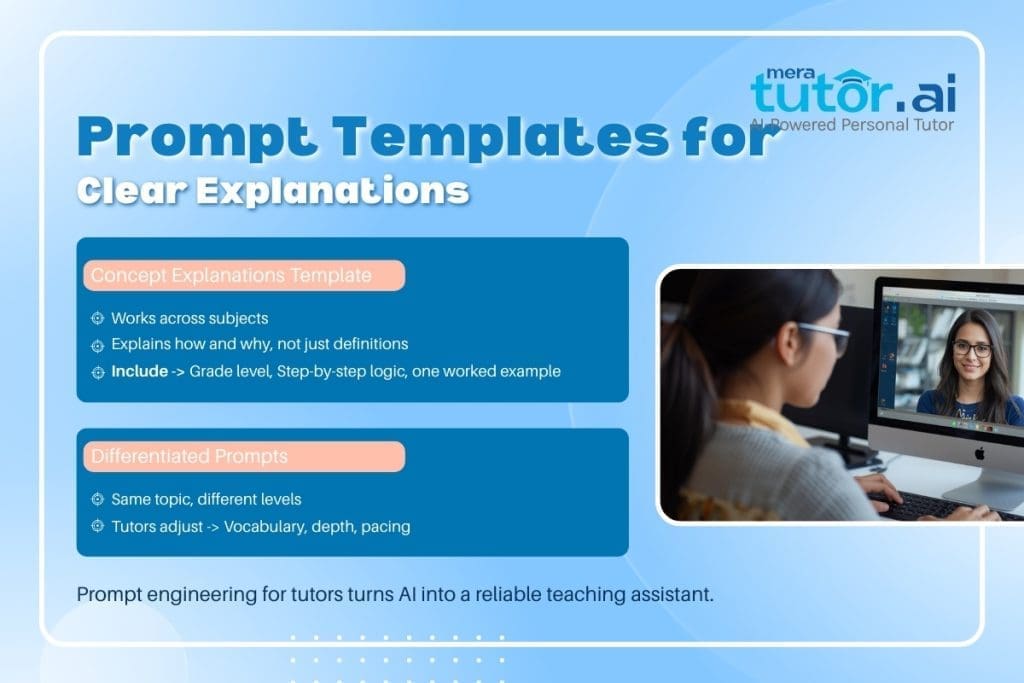
A strong concept explanation prompt should work across subjects such as math, science, or language learning. The goal is to guide the AI to explain how and why a concept works, not just define it.
Key elements to include in the prompt:
- Grade level or learning stage
- Step-by-step logic
- One clear, worked example
Weak Prompt Example
“Explain fractions.”
This prompt provides no context. The AI must guess the student’s age, background knowledge, and the depth of explanation needed, often resulting in an overly generic response.
PARTS-Based Prompt Example
“Persona: Act as a patient math tutor.
Action: Explain the concept of fractions.
Rules: Use simple language suitable for a Grade 4 student. Avoid advanced terminology.
Task Output: Provide a step-by-step explanation followed by one worked example.
Student Context: The student struggles with understanding parts of a whole.”
This structured approach leads to explanations that are clearer, more accurate, and immediately usable in a tutoring session. Such tutor prompt templates significantly reduce the need for post-editing.
B. Differentiated Explanation Prompts
One of the most powerful uses of educational prompt engineering is differentiation. Tutors can use the same topic while adjusting prompts for different learner levels, ensuring explanations stay aligned with individual needs.
For the same concept, tutors can create variations such as:
- Struggling learner: Slower pacing, simpler vocabulary, more concrete examples
- Average learner: Balanced depth, standard terminology, one or two examples
- Advanced learner: Deeper reasoning, precise vocabulary, connections to related concepts
By explicitly controlling depth, vocabulary, and pacing in the prompt, tutors guide the AI to respond appropriately to each student. This keeps the tutor in charge of instruction while using AI to scale personalized explanations efficiently — turning prompt engineering into a practical, everyday teaching skill rather than a technical exercise.
2. For Practice Questions and Quizzes
Well-designed practice questions are essential for reinforcing learning, and prompt engineering for tutors makes it possible to generate high-quality quizzes that match student needs precisely. Instead of relying on generic question banks, tutors can use structured ai prompts for education to create targeted practice that aligns with lesson goals and learning gaps.
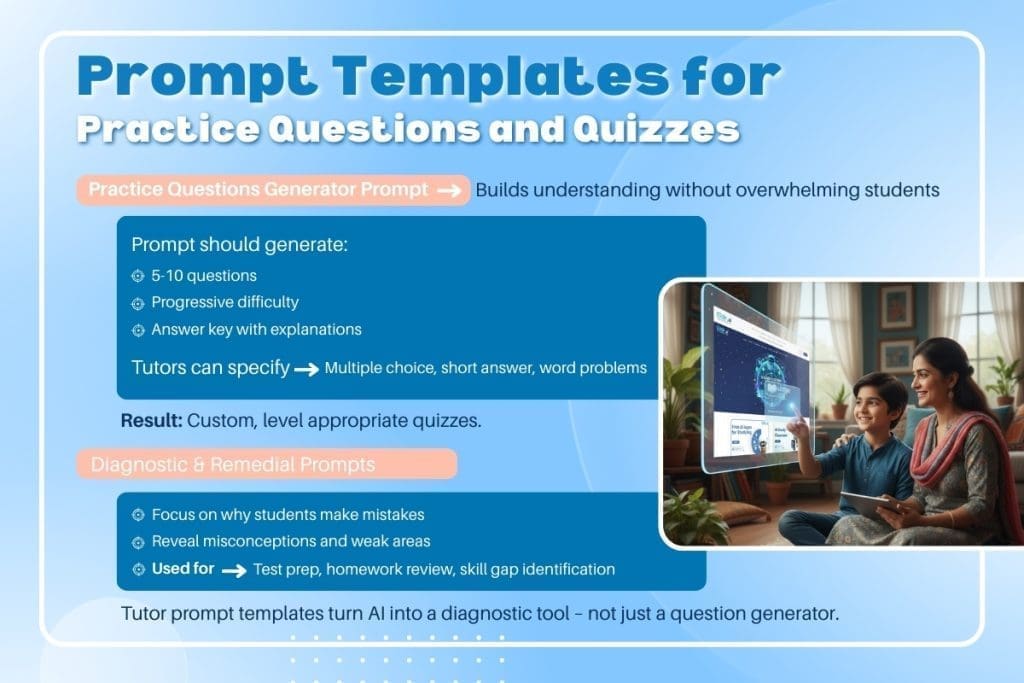
A. Practice Question Generator Prompt
A strong practice question prompt should guide the AI to produce questions that build understanding gradually rather than overwhelm the student. Using a clear structure helps ensure consistency and relevance.
What the prompt should create:
- 5–10 practice questions
- Progressive difficulty, from basic recall to application
- A complete answer key with brief explanations
Options tutors can specify in the prompt:
- Multiple choice questions
- Short answer questions
- Word problems or real-world scenarios
For example, a tutor might instruct the AI to generate 5 multiple-choice questions followed by 3 short-answer questions; all aligned to a specific grade level. On MeraTutor.AI, this approach allows tutors to quickly assemble quizzes that feel custom-built rather than mass-produced.
B. Diagnostic & Remedial Prompts
Beyond general practice, educational prompt engineering is especially powerful for diagnosis and remediation. Tutors can prompt AI to generate questions that focus on common errors or misconceptions, helping pinpoint exactly where a student is struggling.
These prompts can be used to generate:
- Error-focused questions targeting frequent mistakes
- Misconception checks that reveal flawed reasoning
Common use cases include test preparation, homework review sessions, and skill gap identification. By reviewing student responses and refining prompts accordingly, tutors maintain instructional control while using AI to surface patterns that might otherwise take longer to uncover. In this way, tutor prompt templates become tools for insight—not just automation.
3. For Lesson Plans and Tutoring Sessions
Beyond explanations and quizzes, prompt engineering for tutors can also streamline lesson planning and session structure. With the right prompts, AI can help tutors design focused tutoring sessions while leaving instructional decisions firmly in the tutor’s hands. This is especially valuable for busy tutors who want consistency without sacrificing personalization.
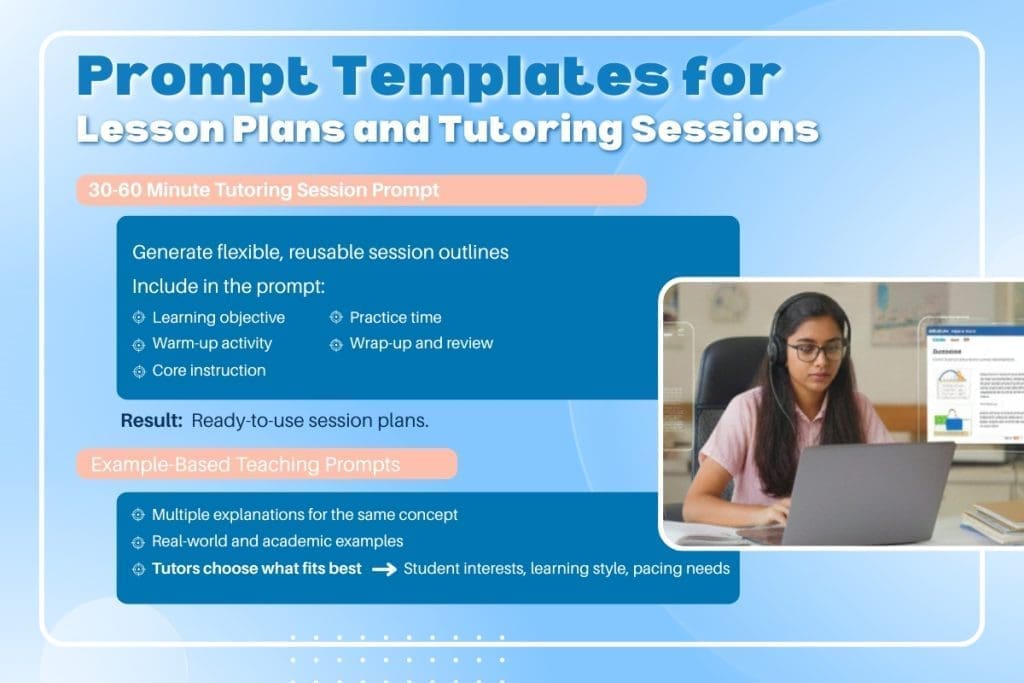
A. 30–60 Minute Tutoring Session Prompt
A well-structured tutoring session prompt guides the AI to produce a clear session outline that tutors can adapt as needed. Instead of starting from scratch, tutors can generate a flexible framework in seconds.
A strong session-planning prompt should include:
- Clear learning objective aligned with the student’s goals
- Short warm-up to activate prior knowledge
- Core activity focused on instruction or demonstration
- Guided or independent practice
- Wrap-up to review key takeaways and next steps
When tutors specify time duration, subject, and student level, AI-generated plans become far more practical. On platforms like MeraTutor.AI, these prompts help tutors prepare repeatable session structures that can be reused across multiple students with minimal adjustment.
B. Example-Based Teaching Prompts
Examples and analogies are often what make difficult concepts click for students. Using ai prompts for education, tutors can ask AI to generate multiple explanations of the same idea from different angles.
Tutors can prompt AI to:
- Generate real-world analogies tied to everyday experiences
- Provide multiple examples from different academic or practical contexts
The key advantage is choice. Tutors review the generated examples and select the ones that best fit the interests, backgrounds, and learning styles of their students. This keeps the tutor in control of pacing and emphasis while using educational prompt engineering to expand the range of teaching tools available during a session.
How MeraTutor.AI Embeds Prompt Patterns for Tutors
One of the biggest challenges in prompt engineering for tutors is consistency. Writing strong prompts every time can take practice, especially when tutors are balancing multiple students, subjects, and levels. This is where Meratutor distinguishes itself by embedding prompt patterns directly into the tutoring workflow.
A. Built-In Prompt Structures
MeraTutor.AI supports tutors by incorporating proven prompt structures into its features and tools. Instead of starting from a blank prompt, tutors work with guided patterns that reflect best practices in educational prompt engineering. These built-in structures reduce trial-and-error by prompting tutors to specify key elements such as student level, learning goals, and output format.
By standardizing how prompts are created, MeraTutor.AI helps tutors generate clearer explanations and more aligned practice questions with less effort. This allows tutors to focus on teaching decisions rather than troubleshooting AI responses.
B. Tutor-in-the-Loop Design
A core principle of Meratutor is keeping the tutor firmly in the loop. Tutors remain in control at every stage of the process. They can edit AI-generated outputs, adjust difficulty levels, and personalize explanations to match a student’s needs and learning style.
This design reinforces the idea that AI is a support tool, not an authority. Tutors apply their judgment and experience to refine outputs, ensuring that every explanation or activity aligns with instructional goals.
C. Why This Matters for Responsible AI Use
Embedding prompt patterns and tutor oversight leads to more consistent outputs across tutoring sessions. It also lowers the risk of misleading or misaligned explanations by encouraging structured input and human review.
Most importantly, this approach scales best practices in responsible AI use. Tutors who develop effective prompting habits can apply them repeatedly across students and subjects, creating a reliable, ethical, and student-centered way to use AI in education.
Conclusion
The central lesson of prompt engineering for tutors is simple: it is a teaching skill, not a technical one. Effective prompts reflect the same thinking tutors already use every day—clarifying goals, understanding students, and choosing the right level of explanation. When tutors apply this mindset, AI becomes far more useful and far more reliable.
Tutors who master prompting consistently get better explanations, better practice questions, and significantly less preparation time. Instead of correcting vague or misaligned outputs, they can focus on refining instruction and responding to student needs. Platforms like MeraTutor.AI are designed to support this approach by reinforcing structured, tutor-led use of AI.
The best place to start is with simple frameworks like PARTS. These prompt patterns make expectations clear, reduce errors, and scale well across subjects and students. Most importantly, tutors should always treat AI as an assistant—not an authority. When tutors lead and AI supports, technology enhances learning without replacing the human expertise that effective tutoring depends on.
FAQs
1. What is prompt engineering for tutors?
Prompt engineering for tutors is the practice of writing clear, structured instructions that guide AI to generate accurate explanations, practice questions, and lesson materials aligned with student needs and learning goals.
2. Why is prompt engineering important in tutoring?
Prompt engineering matters because AI responds to the quality of instructions, not intent. Well-written prompts help tutors get level-appropriate explanations, reduce errors, and maintain instructional control while using AI efficiently.
3. How does prompt engineering improve AI explanations for students?
Structured prompts specify grade level, format, and learning context, allowing AI to deliver clearer, step-by-step explanations with relevant examples instead of generic or overly complex responses.
4. What is the PARTS framework in educational prompt engineering?
The PARTS framework stands for Persona, Action, Rules, Task Output, and Student Context. It helps tutors create consistent, safe, and instructionally relevant AI prompts, including Gemini-style prompting.
5. Can tutors use the same AI prompt for different students?
Yes. Tutors can reuse prompt templates by adjusting the student context, difficulty, or rules. This makes prompt engineering scalable across students and subjects while preserving personalization.
6. How does prompt engineering support responsible AI use in education?
Prompt engineering encourages clear constraints, verification, and tutor oversight. This reduces misinformation, prevents off-level content, and ensures AI supports learning rather than replacing human judgment.
7. What types of content can tutors generate with AI prompts?
Tutors can generate explanations, practice questions, quizzes, diagnostic assessments, lesson plans, session outlines, and real-world examples using structured ai prompts for education.
8. How does MeraTutor.AI support prompt engineering for tutors?
MeraTutor.AI embeds tutor-friendly prompt patterns that reduce trial-and-error, support responsible AI use, and keep tutors in control of explanations, difficulty, and personalization.
9. Is prompt engineering a technical skill?
No. Prompt engineering is a teaching skill. It reflects how tutors already think—defining goals, understanding students, and setting constraints—then translating that thinking into clear instructions for AI.
10. What is the biggest mistake tutors make when using AI?
The most common mistake is using vague prompts without student context or learning objectives. This often leads to generic outputs that require heavy editing or don’t match the student’s level.
Ready to Use Prompt Engineering in Your Tutoring?
If you want clearer explanations, better practice questions, and less prep time, it starts with using the right prompt structures in the right environment. Prompt engineering for tutors works best when the platform is built around teaching workflows—not generic AI chat.

MeraTutor.AI is designed to help tutors apply proven prompt patterns for explanations, quizzes, and lesson planning—while keeping full control over instruction. Start using AI as a reliable teaching assistant, refine your prompts as part of your tutoring craft, and spend more time where it matters most: helping students learn.
Sign Up Now
